
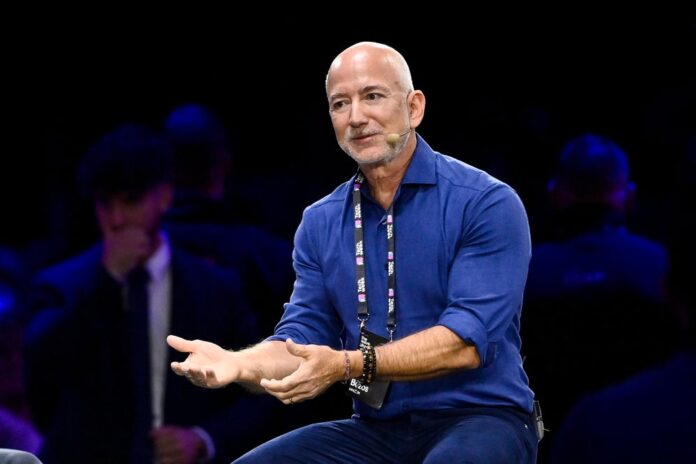
Jeff Bezos’ Remarks on Government Efficiency Trigger Political Debate
New York: Amazon founder Jeff Bezos has once again found himself at the center of a heated political and economic discussion after criticizing government efficiency during a recent interview. His comments, which compared Amazon’s operational efficiency with the functioning of New York City’s public school system, have sparked widespread reactions from business leaders, politicians, and policy experts.
The debate intensified after Canadian entrepreneur and “Shark Tank” investor Kevin O’Leary publicly backed Bezos, arguing that successful business leaders possess the management skills needed to improve government institutions. However, former New York City Mayor Bill de Blasio strongly rejected Bezos’ remarks, calling them disconnected from the realities faced by ordinary citizens.
The exchange has quickly evolved into a broader discussion about taxation, public spending, government accountability, and the role of business leaders in shaping public policy.
Bezos Questions Government Efficiency
Speaking during an interview with CNBC, Jeff Bezos argued that increasing taxes on wealthy individuals alone would not solve the structural problems affecting public services.
To illustrate his point, Bezos said that if Amazon operated the way New York City’s public school system functions, customers would have to wait weeks to receive their packages. According to him, operational efficiency—not simply higher tax collection—is the key factor in improving public services.
Bezos also stated that even if the taxes he personally pays were doubled, the additional revenue would not automatically improve education outcomes unless underlying inefficiencies within government departments are addressed.
His comments have reignited long-running debates about how governments should balance taxation with administrative reforms.
Kevin O’Leary Backs Bezos
Canadian billionaire Kevin O’Leary quickly expressed support for Bezos’ position.
O’Leary described New York City’s administration as an example of inefficient governance and argued that more experienced entrepreneurs should play a greater role in public administration. According to him, individuals who have successfully built global businesses understand how to manage resources, improve productivity, and eliminate waste.
He also defended high-income earners against calls for increased taxation, arguing that entrepreneurs contribute significantly through investments, innovation, and job creation. In his view, government inefficiency—not the tax contributions of wealthy individuals—is the larger economic concern.
His remarks have further intensified discussions around whether successful corporate executives could bring valuable management practices into government institutions.
Political Leaders Push Back
Not everyone agreed with Bezos and O’Leary.
Former New York City Mayor Bill de Blasio sharply criticized Bezos’ comments, calling them insensitive to the challenges faced by working families.
According to de Blasio, comparing a multinational technology company with a public education system ignores the social responsibilities and complexities involved in running government services. He argued that schools serve millions of students from diverse economic backgrounds and cannot be evaluated using the same performance metrics as a private corporation focused on profitability.
The criticism reflects a broader political divide over how governments should prioritize efficiency while maintaining public welfare and equal access to essential services.
Tax Policy Remains at the Center of the Debate
The controversy comes at a time when New York lawmakers are discussing tax reforms aimed at increasing revenue from luxury real estate and high-income individuals.
Supporters of the proposals argue that additional tax revenue is necessary to fund education, healthcare, and infrastructure projects. Critics, however, believe excessive taxation could discourage investment, reduce economic activity, and encourage wealthy individuals and businesses to relocate to lower-tax regions.
Bezos has maintained that although taxation is an important part of public finance, sustainable improvements require governments to modernize operations and improve efficiency alongside revenue generation.
Bezos on Artificial Intelligence and Jobs
The latest controversy follows another recent statement by Bezos regarding artificial intelligence and employment.
Contrary to concerns that AI will eliminate millions of jobs, Bezos believes the technology could actually create labour shortages rather than widespread unemployment.
Speaking at an international technology conference, he argued that AI will automate repetitive tasks, allowing workers to focus on more productive and creative responsibilities. According to Bezos, technological revolutions have historically transformed jobs instead of eliminating them completely.
He also believes AI will become a productivity tool that enables businesses to expand faster, ultimately increasing demand for skilled workers across multiple industries.
A Debate That Continues Beyond Business
The differing opinions expressed by Bezos, O’Leary, and de Blasio highlight the ongoing global debate over taxation, government efficiency, and economic policy.
Supporters believe experienced entrepreneurs can offer practical solutions to improve public administration, while critics argue that governments must prioritize social welfare over corporate-style management approaches.
As governments worldwide continue to face rising public expectations, budget pressures, and rapid technological change, discussions about efficiency, taxation, and leadership are likely to remain central to economic and political conversations in the years ahead.