
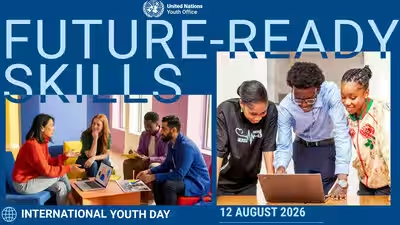

International Youth Day is being observed on August 12, 2026, under the global theme “Different Contexts, Common Aspirations”. The United Nations is highlighting the shared aspirations of young people, including quality education, decent work, meaningful participation, opportunity and a sustainable future.The theme also draws attention to young people in Least Developed Countries, Landlocked Developing Countries and Small Island Developing States, where poverty, climate change, geographic isolation and unequal digital access can create additional barriers to education and employment.UN Secretary-General António Guterres said young people are already “leading the way as organizers and innovators”, but need access to skills including critical thinking, problem-solving and digital literacy to prepare for the future.As artificial intelligence changes workplaces and the skills required across industries, students are increasingly expected to combine technical knowledge with judgement, creativity, communication and responsible technology use. Seven skills are particularly relevant to careers in an AI-enabled economy.1. Data literacy and analytical thinkingStudents need to interpret datasets, recognise bias and use evidence when making decisions. AI can process information quickly, but analysing context and converting findings into practical strategies requires human judgement.2. Prompt engineering and AI collaborationGenerative AI is becoming part of everyday work. Students need to learn how to provide clear, detailed and contextual instructions, assess AI responses and use these systems effectively as collaborative tools.3. Critical thinking and fact verificationAI-generated content can contain errors, while deepfakes can make false information harder to identify. Students should verify claims, compare reliable sources and scrutinise AI-generated answers before using them.4. Adaptability and lifelong learningTechnology can change job requirements rapidly. The ability to learn new tools, update knowledge and adapt to changing responsibilities will remain important as industries adopt new AI systems.5. Emotional intelligence and communicationEmpathy, active listening, self-awareness and cross-cultural communication remain important in workplaces. These skills support collaboration, negotiation and effective interaction with colleagues and clients.6. Creative problem-solvingAI can identify patterns in existing information, while human creativity remains important when dealing with unfamiliar problems. Students can develop this skill by questioning assumptions and combining ideas from different fields.7. Ethics, bias and AI governanceStudents also need to understand responsible AI use. Awareness of algorithmic bias, fairness and accountability can help future professionals identify risks when AI is used in areas such as recruitment, finance and education.
AI skills are receiving global investment
S&P Global and the S&P Global Foundation announced a three-year, $10 million StepForward initiative to expand AI education and workforce-readiness programmes for young people. The initiative includes Generation, MIT RAISE and regional organisations, alongside collaborations involving IIT Hyderabad, the National University of Singapore and the Stanford Institute for Human-Centered AI.The UN Youth Office is also participating as a global collaborator, with a campaign focused on future-ready skills for young people entering changing labour markets.