
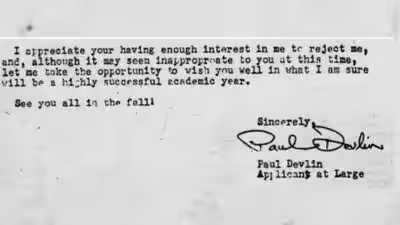
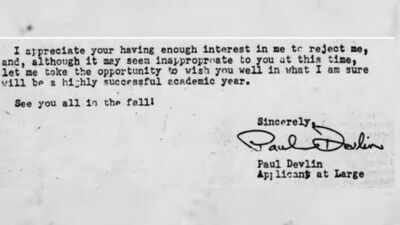
In 1981, a student who was rejected by Harvard University decided he wasn’t going to let the letter have the final word. Instead, he wrote back to reject Harvard’s rejection.Paul Devlin wrote back to Harvard a humorous letter after noticing that the rejection letter from Harvard contained a grammatical error. That prompted him to send a reply saying he could not ‘accept’ Harvard’s rejection.Devlin’s mother sent a copy to The New York Times, where it was published in the newspaper’s New Jersey section on May 31, 1981. More than four decades later, the letter continues to be shared online and has even been performed at a public reading.Devlin, who later became an Emmy-winning documentary filmmaker and sports editor, recalled that the idea came after he spotted a grammatical mistake in Harvard’s rejection letter.“I noticed that the rejection letter I received from Harvard had a grammatical error,” Devlin wrote. “So, I wrote a letter back, rejecting their rejection letter.”Devlin copied the formal tone often used by universities and turned it around. In the letter, he treated Harvard’s rejection as though it was an application that he had carefully reviewed before deciding not to accept it.He opened the letter by writing, “Having reviewed the many rejection letters I have received in the last few weeks, it is with great regret that I must inform you I am unable to accept your rejection at this time.”

Devlin later became an Emmy-winning documentary filmmaker (Picture: Paul Devlin’s official website)
He continued by saying he had received “an especially fine crop of rejection letters” from many colleges but that he could only accept a limited number of them.He wrote that every rejection had been reviewed “carefully and on an individual basis” and that he had considered several factors, including the size of the institution, student-faculty ratio, location, reputation, costs and social atmosphere.He also joked that although the colleges were qualified to reject him, “some mistakes were made in turning away some of these rejections.”The letter also acknowledged that Harvard might be disappointed by his decision. “I am aware of the keen disappointment my decision may bring,” Devlin wrote.He added that he had considered the time and effort Harvard had spent reaching its decision to reject him. He even claimed that some rejection letters had met his “traditionally high standards” but still could not be accepted because he had to make difficult choices.The letter ended with another humorous line. “I appreciate your having enough interest in me to reject my application. Let me take the opportunity to wish you well in what I am sure will be a successful academic year.”It concluded with the words “SEE YOU IN THE FALL!” He signed it as “Paul Devlin, Applicant at Large.”