
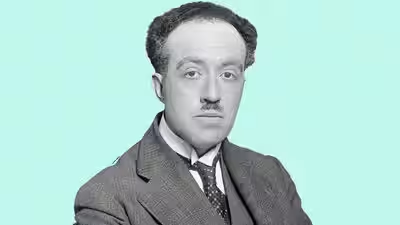
Most students change their majors once and never look back. Louis de Broglie did exactly that — and ended up changing the course of modern physics.Born into a French aristocratic family on August 15, 1892, de Broglie didn’t begin his academic journey as a scientist. He initially studied history at the Sorbonne in Paris and completed his degree in 1910, with plans to pursue a career in the humanities. Later, his growing interest in mathematics and science pushed him in an entirely different direction.That decision would eventually influence everything from quantum mechanics to electron microscopes.
A simple question that puzzled the scientific world
At the beginning of the 20th century, physicists were struggling to understand the true nature of light.Was light a wave?Or was it a particle?The work of scientists such as Albert Einstein and Max Planck had already suggested that light could behave as both. But de Broglie decided to ask an even more radical question:
If light can behave like a particle, why can’t particles behave like waves?
That single question became the foundation of his 1924 doctoral thesis, Researches on the Quantum Theory. In it, he proposed that matter itself possesses wave-like properties — an idea that became known as the de Broglie hypothesis.
Einstein immediately recognised its importance
The story behind the thesis is almost as fascinating as the theory itself.According to historical accounts, de Broglie’s examiners were uncertain about his ideas because they challenged conventional thinking. The thesis was sent to Einstein, who immediately recognised its significance and reportedly remarked that the young French physicist had “lifted a corner of the great veil.” This endorsement helped bring serious attention to the work.
Science proved him right just three years later
Scientific theories become truly influential only when experiments confirm them.That happened in 1927.Physicists Clinton Davisson and Lester Germer demonstrated electron diffraction, proving that electrons could indeed behave like waves. Another independent experiment by George Paget Thomson reached a similar conclusion.Suddenly, de Broglie’s once-controversial thesis became one of the foundations of quantum mechanics.
A Nobel Prize for a doctoral thesis
In 1929, at just 37 years of age, Louis de Broglie received the Nobel Prize in Physics for discovering the wave nature of electrons. The Nobel Committee described the award as recognition for his “discovery of the wave nature of electrons.”His work later inspired Erwin Schrödinger to develop wave mechanics, leading to the famous Schrödinger equation that remains central to quantum physics today.
Why students should remember Louis de Broglie
The biggest lesson from de Broglie’s journey isn’t about physics.It’s about intellectual curiosity.He wasn’t a child prodigy who spent his entire life in laboratories. He was a history student who changed disciplines, questioned accepted ideas, and dared to connect two seemingly unrelated concepts.His theory eventually made technologies such as electron microscopes possible, allowing scientists to observe structures far smaller than what conventional light microscopes can reveal.More than a century after he wrote his doctoral thesis, Louis de Broglie’s story continues to remind students that sometimes the most powerful discoveries begin with a simple question: What if everyone else is looking at the problem the wrong way?Disclaimer: This article was prepared by TOI Education using information from historical records, Nobel Prize archives and other publicly available scientific sources.