
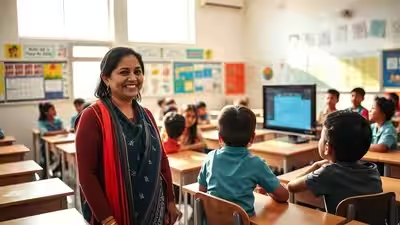

The Gautam Buddh Nagar administration has directed all government, aided and private schools in Noida and Greater Noida to limit students’ daily exposure to smart and digital boards. The move follows complaints from parents that children were spending four to five hours a day in front of screens during regular classroom teaching.Under the new guidelines, screen use through smart and digital boards must not exceed 30 minutes a day for primary students and 60 minutes for upper-primary students. Designated magistrates and nodal officers will monitor compliance in schools across the district.
Parents raise concerns over prolonged screen use
According to the administration, parents’ associations had raised concerns about the continuous use of digital boards in classrooms. Schools were reportedly using the screens not only for presentations but also to display textbooks, conduct classroom exercises, question-and-answer sessions, and assign homework.The administration said smart boards should remain a supporting teaching tool rather than becoming the primary medium of classroom instruction according to media reports.“Smart and digital boards are a supplementary medium” for making teaching more effective, the authority said, while stressing that their excessive use should not interfere with students’ health, studies, sports, and other activities.Schools asked to return to traditional boards for some activitiesThe guidelines make it clear that digital technology should be used selectively. Smart boards should primarily help teachers explain difficult concepts and show relevant images, videos, and other teaching material.For writing practice, exercises, question-and-answer sessions, and interactive classroom work, schools have been asked to regularly use blackboards, whiteboards, or greenboards.The administration has also asked schools to maintain suitable screen brightness and adequate classroom lighting. Students should be seated at an appropriate distance from screens and given breaks after about 20 minutes of screen exposure.
20-20-20 rule for online classes
For online classes, schools have been advised to follow NCERT recommendations on session duration and breaks. The guidelines also refer to the 20-20-20 rule, under which students should look at an object at least 20 feet away for 20 seconds after every 20 minutes of screen use.The administration said prolonged exposure to screens could contribute to problems such as eye strain, short-sightedness, headaches, and difficulty concentrating.Schools have therefore been encouraged to increase activity-based learning, reading, writing, sports, group activities and physical exercise.
Schools told to conduct regular eye examinations
The administration has asked schools to promptly inform parents if students report symptoms such as eye irritation, headaches, or blurred vision. Medical advice should be sought where necessary.Schools have also been directed to conduct eye examinations every quarter and share the reports with parents.School Management Committees will discuss the guidelines on the balanced use of smart and digital boards and student health. Details of these discussions are to be shared with parents during parent-teacher meetings.
Digital-free periods encouraged
As part of the effort to reduce students’ dependence on screens, schools have been encouraged to introduce digital-free periods, digital zero days and digital detox activities.The objective is to give children more time for sports, creative pursuits, reading and face-to-face social interaction.The administration has assigned designated magistrates and nodal officers to monitor implementation. They will submit compliance reports through the District Inspector of Schools, Gautam Buddh Nagar.The move places a clear emphasis on balancing technology-driven education with traditional classroom methods and activities that support children’s physical, academic and social development.