
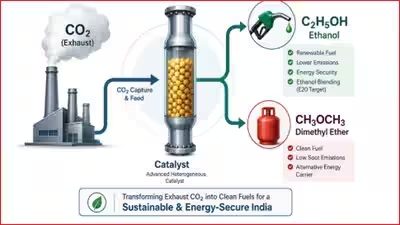
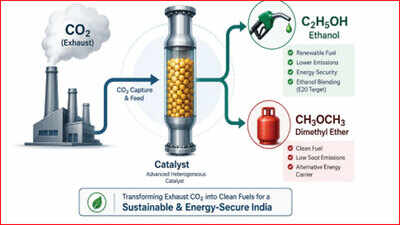
For decades, scientists around the world have been trying to answer one difficult question: Can carbon dioxide (CO₂), one of the biggest contributors to climate change, be turned into something useful instead of being released into the atmosphere?At the Hyderabad campus of BITS Pilani, a team of professors, undergraduate students, postgraduate students, and PhD scholars spent five years searching for an answer.What they developed could have implications far beyond a university laboratory.The team created a catalyst capable of converting captured CO₂ emissions from power plants, steel factories, and cement industries directly into dimethyl ether (DME), a clean-burning fuel that can supplement liquefied petroleum gas (LPG). The technology has already completed laboratory validation and is now moving towards pilot-scale development.But perhaps the most interesting part of the story is this: it shows how students working alongside faculty members can develop technologies aimed at solving real-world problems.
Three professors, one laboratory and a five-year journey
The project was led by Prof. Sounak Roy, Dean of Research and Innovation, along with Prof. B. M. Reddy and Prof. Satyapaul A. Singh at BITS Pilani’s Hyderabad campus.Over five years, more than 10 undergraduate, postgraduate and doctoral students contributed to the project, refining the catalyst, testing different reaction conditions and overcoming multiple engineering challenges.The research received approximately ₹45 lakh in funding from the Anusandhan National Research Foundation (ANRF), while the work was carried out at the institute’s Materials Centre for Sustainable Energy and Environment, a facility developed at a cost of around ₹5 crore.
Why this research matters to every Indian household
India imports a significant portion of the LPG consumed in the country.That dependence creates both economic and energy security challenges.According to estimates cited by the researchers, India’s annual LPG import bill is around ₹1.06 lakh crore.The BITS team believes their technology could eventually reduce some of that dependence by converting industrial waste into a usable fuel. The country’s policy framework already allows blending DME with LPG, creating a pathway for future adoption.
The science behind the breakthrough is surprisingly simple
Traditional DME production usually follows two separate steps.First, carbon dioxide is converted into methanol. Then, methanol is converted into DME.The BITS team combined both reactions into a single-step process.One part of the specially designed catalyst converts carbon dioxide into methanol, while another part simultaneously converts methanol into dimethyl ether.Reducing the process to a single reactor decreases engineering complexity, lowers energy consumption and could make large-scale deployment more economically attractive.
Students didn’t just assist; they helped build the technology
This isn’t a story about a scientific paper sitting in a journal archive.Students participated in catalyst development, laboratory testing, process optimisation and reactor design.The team had to simulate industrial conditions inside the laboratory by carefully adjusting temperature, pressure, gas flow rates and feed composition.Working with hydrogen at very high pressures also meant designing systems with extensive safety mechanisms.Then came another obstacle: the Covid-19 pandemic.Supply chain disruptions and semiconductor shortages delayed equipment fabrication, forcing researchers to adapt while continuing to improve the technology.Yet the project continued moving forward.
From a university laboratory to industries and investors
The technology has already attracted attention beyond academia.The research team was invited to present its work at Bharat Innovates 2026 in Nice, France, where the technology was showcased to Indian and French investors. Several private companies have also expressed interest in collaborating with BITS Pilani to develop pilot-scale projects.
The bigger lesson for students
For years, critics have argued that Indian universities produce research papers but rarely develop technologies capable of changing industries.This project offers a different narrative.A team of professors and students identified two major national challenges—industrial carbon emissions and dependence on imported LPG—and tried to solve both with a single innovation.The laboratory work is complete. The regulations for DME-LPG blending already exist. The next challenge is scaling the technology for commercial use.Whether or not this particular catalyst eventually transforms India’s energy landscape, it has already demonstrated something equally important: meaningful innovation doesn’t always emerge from billion-dollar laboratories.Sometimes, it begins in a university classroom.Disclaimer: This article has been prepared by TOI Education using information from research reports, institutional publications and publicly available interviews with the BITS Pilani research team. Some claims remain subject to further industrial validation and large-scale implementation.